Phantom Graveyard
Project start 2017-01-31
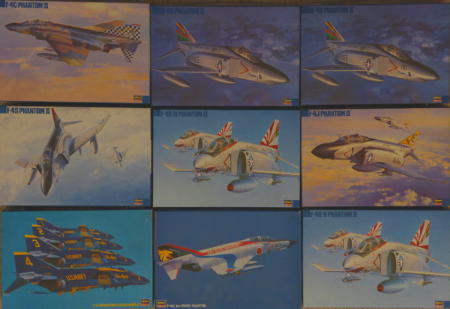
A few months ago, the owner of Flash Aviation asked me if I'd be interested in a number of half built, and thus unsellable Phantoms, which might or might not be complete. If it means I get to go home with a pile of phantomesque plastic, I am of course always happy to help take out the trash. Once home, I sat down for some serious inspection and inventory work, and it turned out that although started, they were all essentially complete, and that the work done by the previous owner was of very decent quality. In other words, I had nine second hand Phantoms on my hands, with, as they say, one careful owner.
I have a ridiculous pile of Phantoms in the stash, plastic for every set of interesting markings I
ever managed to get my hands on. So, what to do with these? Duplicates smell of production work,
for which I feel a moral obligation to demand payment. New subjects sounds great, but if I'd been
able to come up with any, they would have been in the stash by now.
Most of the kits are of types that have seen combat, and those that aren't, can easily be converted to such. In combat, bad things occasionally happen to men and machines. Since these were, in a way, all dead Phantoms, I decided to build them as just that: Phantoms that had been lost during combat operations.
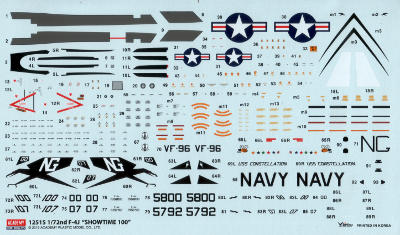
OK, workable idea, but this was going to take some research to see if it could be done. The first candidate was easy, since Cunningham and Driscoll's Showtime 100 is not exactly hard to find decals for, and although is made aces of it's crew, the plane itself did not survive the mission and went down after an excounter with a SAM on the way home. Arriving back on the boat in a search and rescue helo, and without their Phantom, was probably not the homecoming the crew had in mind, but it's an easy start for my little project. I had the brand new tool Academy in the stash, which has decals for this very plane, so I committed a spot of larceny, et voila, the first kit was ready to go.
The others were a bit more work, but I found a website which listed all F-4 losses suffered by the US. Very helpful. Air force Phantoms are a bit boring, really, as they rarely have more distinguishing features than tail numbers and perhaps the occasional shark mouth. Thus, they were a matter of jotting down the numbers for later decal creation. For the USN and USMC machines I managed to find lost machines for squadrons for which the kits included decals anyway. This reduced those to a number printing excercise as well. to my rather immense relief. The only kit I didn't manage to find a suitable use for, was the second RF-4B. Although several were lost, all were from the same squadron, and aside from different numbers, they were identical. Too boring. Only one of the recce birds will be built, the other will form the core of the Hasegawa spare parts box. Useful, since backdating the F-4S will require hard wings, which I don't have in excess in this pile.
2017-04-23
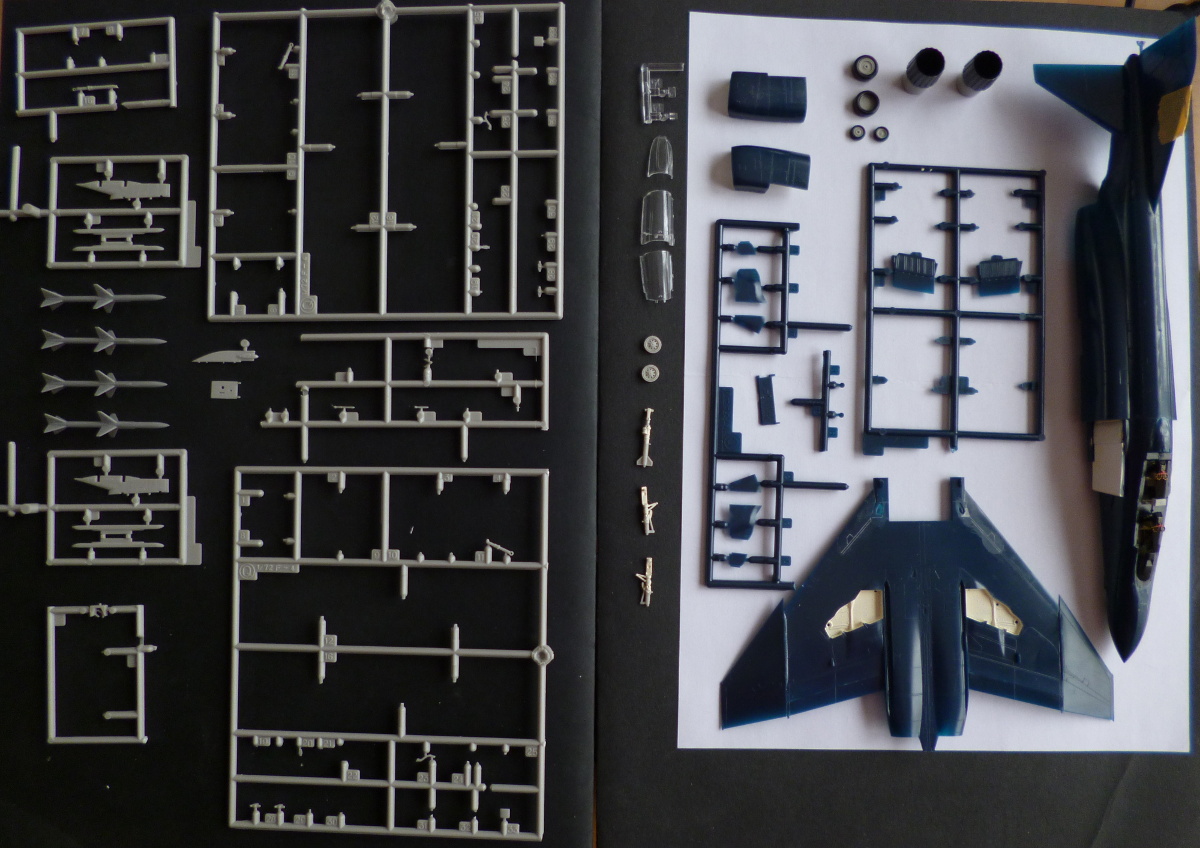
The cockpit on Showtime 100 was nicely done, and pretty much complete, so I've started the process
of closing the multi-part canopy. Not surpisingly, fit is excellent.
The original owner clearly intended to build this model OOB, which implies Blue Angel colours, and
no weapons except for the customary four fake Sparrows. That won't work for a Vietnam war plane; as
far as I can determine, on it's final flight Showtime 100 carried two Sparrows in the rear bays,
a big centreline fuel tank, and 2 AIM-9D Sidewinders plus 3 Rockeye clusterbombs on each of the
inner wing pylons. My predecessor had thrown out all the external tanks, and the reinforcement plates
for the inner pylons, but oddly (although I'm not complaining), the pylons themselves and the
associated Sidewinder rails are still there. He'd also opened up the slots for the Sparrow fins in
all four bays, which means I'll have to fix the forward ones, and of course hadn't opened the
locator holes for the inner pylons prior to assembling the wings. Some fiddling with a very bright
flashlight shining through the wings made the location of the holes very visible though, so this
was easily fixed. The spares box supplied most of the things under wings, and the EJ didn't really
want that navy centreline tank anyway. That leaves the reinforcement plates to dig up.
2018-06-01
The reinforcement plates have been found in a pile of spare parts for Hasegawa Phantoms a fellow
modeller wanted to be rid of. As I said earlier: always happy to help take out the trash
Construction can resume.
2025-10-10
Well, a project this large was certain to go on hiatus a few times, but an eight year break was
not what I expected to record. Still, the kits never left the bench, and they finally caught my
eye again.
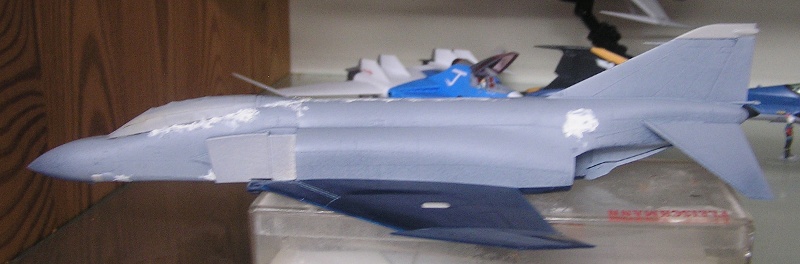
Renewed inspection showed some issues with Showtime. The previous owner had installed a fin cap
without any housings on it, correct for a Blue Angels machine, but not for an operational one.
Fortunately, I still had a correct cap, and the old one snapped off very cleanly. The base coat
of primer on the fuselage, which was probably the last thing I did years ago, clearly showed
some seams needing filler, but this was just minor work. While testing the join of the wings
to the fuselage, it became apparent that the front of the fuselage is ever so slightly rotated
relative to the rear end. No way this can be corrected, but fortunately, it looks like I can
fudge this over so that it won't be obvious. That did require the wings to be rotated to a similar
degree at the front, so a bit of filing and shimming was needed.
One of the pitots on the fin has broken off. The little bastards always do that, but even with
considerable experience, it's still a nuisance to have to reconstruct them.
I chose not to remove the masking tape from the canopy. It's been on for all those years, and if
that is going to cause trouble, I doubt a few more months will make it worse.
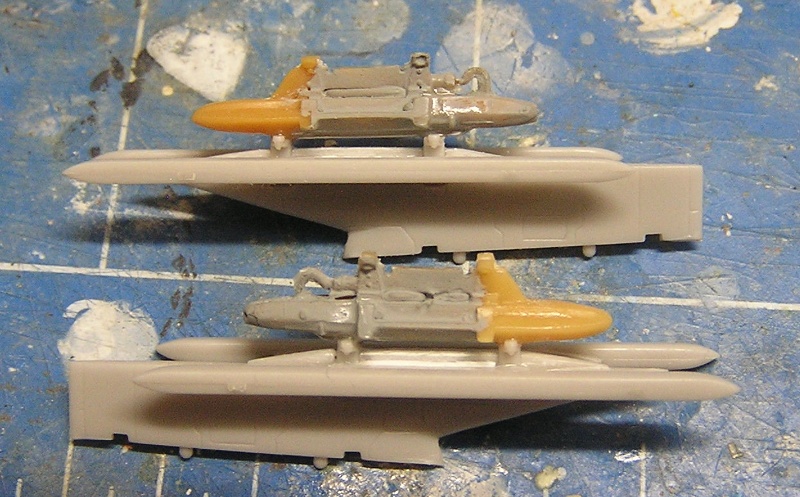
I wanted the inner pylons completely assembled prior to fitting them to the wings. Fiddling
all the bits into some semblance of correctness seemed like enough of a challenge without
the rest of the airplane getting in the way; there's five parts in each pylon, not counting
the reinforcements between wings and pylons, and the TERs are resin copies, which are
impervious to plastic cements. I like how they came out, and just hope I won't snap off bits
during the rest of the build.
2025-10-11
I've found that not only did the previous owner not drill out the locator holes for the ECM
antennas on the air intakes, he binned the antennas. Unkind comments about premature optimisation
came to mind as I dove into the pile of spare parts. No luck there either. I was saved by the
F-4C which is destined to become "Owl 08". The F-4C didn't have those antennas, but the kit
still had them. Since the holes have to be drilled through raher thick plastic, and the insides
of the F-4J intakes have a thick coat of gloss white on them and some small probes already
installed, I swapped out the complete intakes between the kits. That will still require getting
past the filler covering up the holes on the inside, but it should work.
2025-10-11
I'm feeling rather stupid at this point. The whole procedure with the intake antennas went
perfectly, and prior to actually fitting them, I grabbed the instructions to see which
antenna belonged on which side of the airplane. That's when I noticed the antennas apparently
were not fitted to all F-4Js. With the proverbial sinking feeling in full swing, I went
looking for references of the real thing (fortunately, the plane is quite famous), and found
some period photographs confirming that Showtime 100 did in fact NOT have the antennas.
There's more kits out there, with subjects that do want to jam stuff, so more swappery ensued.
The intakes are now mounted on the model. It took some doing, as everything in that area is just a bit out of whack due to the slight rotation of the front fuselage, and of course everything has to look like there is no such issue. Nothing major, mind, but every join needed attention and either a bit of filling or a bit of filing to preserve the illusion.
While sanding down the previous batch of filler, there was some damage to the tape covering the canopy. I'll have to swap it out prior to the next coat of primer; it's probably still good enough to stop a bit of paint, but I'm not risking it.